
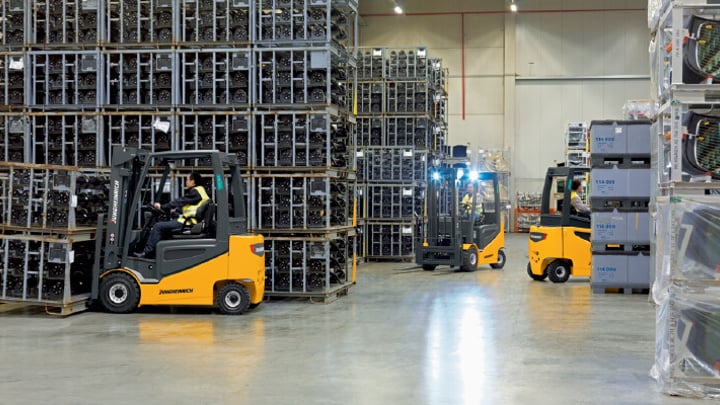
Montacargas eléctricos vs. de combustión interna
Which is better for your application? Learn the key differences between electric and internal combustion engine lift trucks.
One of the most commonly asked material handling questions today is, "Should I use electric or internal combustion (IC) forklift trucks?" Selecting the ideal forklift for your application can save your business time and money. Because work environments and applications can vary significantly, it is extremely important to talk about your specific operation before making a final decision. Your local authorized Jungheinrich, Cat Lift Trucks®, UniCarriers or Mitsubishi forklift truck dealer can provide you with such expertise.
Internal Combustion Forklifts
Applications
Internal Combustion (IC) forklift trucks are ideal for outdoor use, but if fueled by propane, they can be used both indoors and outdoors.
Advantages
- Lower initial cost
- Better for long runs, high speed and ramps
- Capacity of over 35,000 lbs.
- Easy to refuel
Disadvantages
- Indoor use requires good ventilation
- Higher maintenance
- Higher fueling cost
Refueling
The main benefit of an IC forklift is the ability to refuel on the fly; simply load a new LP tank or refill gas or diesel at an OSHA-approved refueling station and your forklift is ready to continue working. The downside is that in some applications, you may be required to refuel during a shift.
Maintenance Cost
Maintenance costs can vary greatly for IC forklifts. IC lift trucks require regular engine maintenance and inspections to support lower long-term repairs and maintenance costs.
Performance
IC forklifts tend to be utilized in heavier-duty applications, such as brick and lumber yards, where larger capacity and performance is required to move the application’s loads. Electric lift trucks have traditionally been offered in lower capacities, however advances in electric lift truck designs are now allowing them to be utilized in more outdoor applications than the past.
Electric Forklifts
Applications
Electric forklift trucks are ideal for working indoors due to their low emissions. However, those with sealed components, including motors, controllers and connectors, can also be operated outdoors.
Advantages
- Produce zero emissions
- Reduced maintenance cost
- Longer economic life
- Lower noise levels
- Lower fueling cost
- Aisle width requirements are less than an IC lift truck
Disadvantages
- Higher initial cost
- Limited availability over 15,000 lbs
- Need for battery changing station
- Need for battery maintenance training
Recharging
The biggest consideration of an electric forklift is the recharging process. A typical battery for an electric forklift will take 8 hours to recharge completely and then an additional 8 hours to cool down before it should be used. For example, a single charge could last from 3 to 12 hours depending on the application and other factors. Depending on the make and model of your forklift, you may need to purchase additional batteries if your operation has multiple shifts. Proper maintenance and the general condition of your batteries can also impact battery life.
Energy efficiency is a key factor to consider when selecting an electric lift truck. Run times are critical to productivity for your operation. For example, Jungheinrich’s new generation of electric warehouse products feature an energy-efficient design, allowing the forklift to run longer on one battery charge. Qualifying models are guaranteed to run 2 Shifts on 1 Battery charge, helping you to move more product, save valuable time and spend less on batteries and chargers for your fleet.
Fuel Cost
Electric lift trucks operate on battery power, resulting in significant fuel cost savings over time.
Maintenance Cost
Maintenance costs on an electric forklift in terms of material and labor is often lower due to less moving parts, requiring less overall maintenance.
Learn More
Still deciding between electric and internal combustion forklifts? Contact your local forklift dealer to learn more about our specific lift truck models and to receive guidance on electric and IC forklifts that are best suited for your application.
Frequently Asked Questions About IC & Electric Forklifts
What kind of fuel does a forklift use?
An internal combustion forklift can use a variety of different fuel types. The most commonly used fuel types for an IC forklift are:
- Compressed Natural Gas (CNG)
- Diesel
- Gasoline
- Liquid Petroleum (LP) Gas
Can you use a propane forklift indoors?
Propane forklifts can be used indoors, but it’s important to closely follow safety practices to ensure that your facility’s air quality is not compromised. When operating a propane lift truck indoors, be sure there’s adequate ventilation, particularly in the winter when most doors and windows are closed. Also, be sure to avoid operating the forklift for extended periods of time in small rooms or trailers where gases can accumulate.
Additional Resources
- Choosing The Right Forklift Type
- How To Charge a Forklift Battery
- Electric Forklift Battery Maintenance Tips
- Why You Should Consider Fast Charging For Extended Battery Life
- What are Tier 4 Forklift Engines?