
Selecting the Right Forklift for Loadouts
Selecting the right forklift for your warehouse is crucial for maintaining an efficient, safe, and productive material handling operation. Whether you’re evaluating a new forklift model or reconsidering the trucks you’ve used for years, it’s important to assess your warehouse needs, operator tasks, and available space. Many warehouses discover that a different forklift type or lift truck model could help operators work more efficiently, reduce fatigue, and improve trailer loading times.
Below are three key factors to evaluate when choosing the best forklift for your warehouse.
1. Frequency of Trailer Loading
Your loading activity plays a major role in determining the right warehouse forklift.
Light to Moderate Trailer Loading
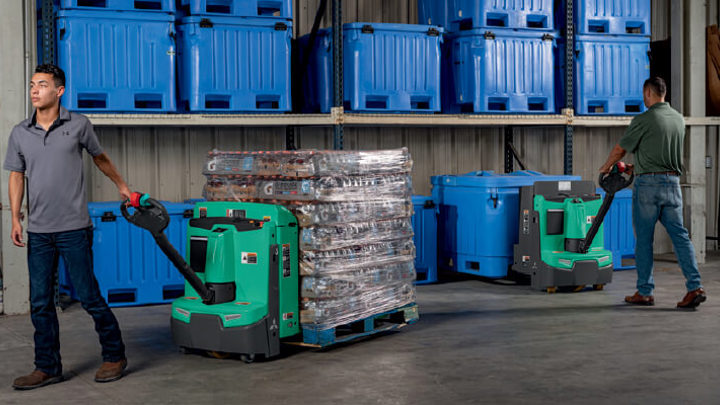
If your shipping department loads only a few semi‑trailers or box trucks each week, an electric walkie or walkie end-rider pallet jack may be a cost‑effective solution—especially if:
- A 3,000–8,000 lb. capacity meets your needs
- You do not require vertical stacking inside the trailer
- The load does not need sensitive or delicate handling
- The transition between the dock floor, dock leveler, and trailer is smooth
Walkies and end-riders are popular electric forklift alternatives for operations that don’t demand full-size rider forklifts.
High-Frequency Trailer Loading
If your shipping team loads trailers continuously throughout the day, a stand-up end control forklift (also known as a stand-up reach or dock stocker model) may be a better fit. These battery-powered forklifts offer:
- Easy entry into standard 108-inch trailer doors
- Mast configurations that allow in-trailer stacking
- 3,000–4,000 lb. capacity, ideal for fast-paced dock work
Stand-up forklifts help operators load and unload quickly while reducing strain from constant on‑and‑off movements.
2. Forklift Operator Duties
Understanding your operators’ daily responsibilities is essential when selecting a forklift.
Operators Performing Multiple Tasks
In many facilities, forklift operators perform more than just loading tasks. They often:
- Replenish production lines
- Store loads in racking
- Move inventory between departments
- Handle paperwork
- Scan barcodes and track loads
For operators frequently entering and exiting the forklift, a stand-up end control forklift provides faster and less fatiguing entry/exit. These models are ideal for multitasking warehouse environments.
Operators on the Forklift All Day
In operations where operators remain on the forklift for most of their shift—loading trailers, handling repetitive loads, or performing nonstop pallet movement—a sit-down counterbalanced forklift is typically preferred. These trucks offer:
- Maximum comfort for long shifts
- High stability
- Easy handling of repetitive, identical loads
Sit-down models are common in high‑volume distribution and manufacturing applications.
3. Available Maneuvering Space
Your warehouse layout and aisle configuration significantly influence forklift requirements.
Wide-Aisle or Open Warehouse Layouts
Warehouses with ample operating space can easily accommodate:
- Four-wheel electric forklifts
- Internal combustion (IC) forklifts
These versatile lift trucks offer excellent stability and higher lifting capacities.
Tight or Crowded Spaces
When maneuvering room is limited—common in fully utilized warehouses, narrow shipping lanes, or tightly packed staging areas—a three-wheel electric forklift is often the best choice. These trucks are favored because they:
- Deliver a tighter turning radius than four-wheel models
- Navigate narrow aisles and tight corners easily
Capacity Considerations
If maneuvering space isn’t an issue, compare based on load capacity:
- Three-wheel electric forklifts max out at 4,000 lbs.
- For heavier loads, a four-wheel forklift is required
Final Thoughts
Choosing the right forklift depends on your warehouse layout, operator responsibilities, and daily loading demands. By reevaluating your current lift truck fleet and understanding your operational needs, you may discover a forklift model that improves efficiency, reduces operator fatigue, and supports safer, more productive material handling.
Find The Right Forklift For Your Business
Let our team of account managers and knowledgeable dealers help you find the best Mitsubishi Forklift Truck solution for your business.