
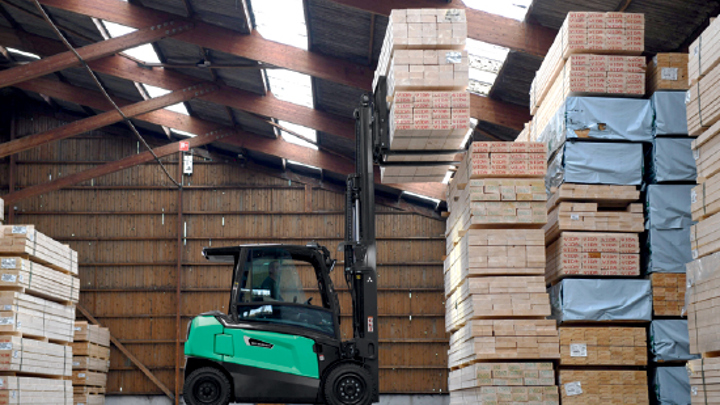
How to Choose the Right Forklift for Your Application
The forklift selection process can be difficult – factors like work environment, shifts, and types of product or loads handled all impact the lift truck you use.
Selecting the right forklift is essential for maximizing productivity, improving safety, and protecting your bottom line. The correct lift truck can streamline workflows, reduce downtime, and support your operators—while the wrong one can slow operations and increase operating costs.
To make the best choice, it’s important to evaluate your application, environment, and performance requirements. Below are key factors to consider and an overview of common forklift types.
Understand Your Application
Every operation has unique needs. Before choosing a forklift, conduct a thorough evaluation of your workspace and requirements. Your local lift truck dealer can assist with a site survey to help determine the correct lift truck model and options.
Key questions to consider:
- How many hours per day will the forklift operate?
- What aisle widths and space constraints must it navigate?
- Will the forklift be used indoors, outdoors, or both?
- What is the average and maximum load weight?
- How high must the lift truck raise its loads?
- What are the load dimensions and shapes? Will attachments be needed?
Understanding these factors will help you select a forklift that fits your environment and productivity goals.
Forklift Types and Their Best Applications
Below is a breakdown of the primary categories of forklifts and where each performs best.
Electric Warehouse Forklifts
Examples: order pickers, pallet jacks, tow tractors, reach trucks, turret trucks
Best for: Indoor warehouses and distribution centers
Advantages:
- Zero emissions and reduced noise
- Compact size for tight aisles and narrow warehouse layouts
- Lower energy and operating costs compared to gas forklifts
- Fewer moving parts, resulting in reduced maintenance
- Cost‑efficient battery recharging
Considerations:
- Higher upfront cost due to battery and charger
- Runtime depends on battery capacity, though many modern electrics support multi‑shift performance
Electric Counterbalanced Forklifts
Electric pneumatic‑tire forklifts offer the performance traditionally associated with internal combustion (IC) trucks—indoors and outdoors.
Advantages:
- Suitable for both indoor and outdoor applications
- Lower maintenance costs, especially when equipped with sealed components
- Zero fuel costs and zero emissions
- Capacities up to approx. 11,000 lbs
Considerations:
- Battery charging and infrastructure must be planned
- Higher initial investment compared to IC options
Diesel Forklifts
Best for: Outdoor, heavy‑duty applications
Advantages:
- High torque and reliable power
- Strong acceleration and lift speeds
- Lower fuel cost compared to gasoline
- Quick refueling
Considerations:
- Not ideal for indoor use due to emissions and noise
- Larger frame size limits maneuverability in tight spaces
LPG / Gas Forklifts
This has historically been one of the most popular forklift choices.
Advantages:
- Versatile for indoor and outdoor use
- Continuous operation with fast refueling
- Strong acceleration, travel speed, and lifting performance
- Engines similar to automotive engines, making parts easier to service
- Compact options available for narrow aisles
Considerations:
- Emissions still present, though lower than diesel
- Fuel costs accumulate over time
Cushion vs. Pneumatic Tires
Pneumatic Tires
Ideal for outdoor settings or uneven terrain.
Available in solid pneumatic or air‑filled options.
Cushion Tires
Best for smooth indoor surfaces such as warehouse floors.
Tip: Traction tires can be added to enhance performance in certain environments.
Final Thoughts
Matching the right forklift to your application is essential for maximizing productivity, protecting your investment, and improving operator efficiency. By assessing your environment, load requirements, and application demands—and understanding the strengths of each forklift type—you can make a confident, informed decision.
Your local forklift dealer can help evaluate your facility, recommend the most suitable models, and assist with attachment selection, fleet sizing, and service planning.
For more information on selecting the right forklift for your business, contact your local Mitsubishi forklift truck dealer.