
6 Steps to Implement AGVs in a Warehouse
Implementing AGVs: A Step-by-Step Guide to Automated Warehouse Efficiency
Automated Guided Vehicles (AGVs) can significantly enhance warehouse efficiency, reduce operational costs, and support long‑term productivity. But for many operations, integrating AGVs into an existing material handling system may seem challenging. In reality, a structured implementation process ensures smooth integration with minimal disruption.
Below are the six key steps typically used to implement AGVs in a warehouse or distribution environment.
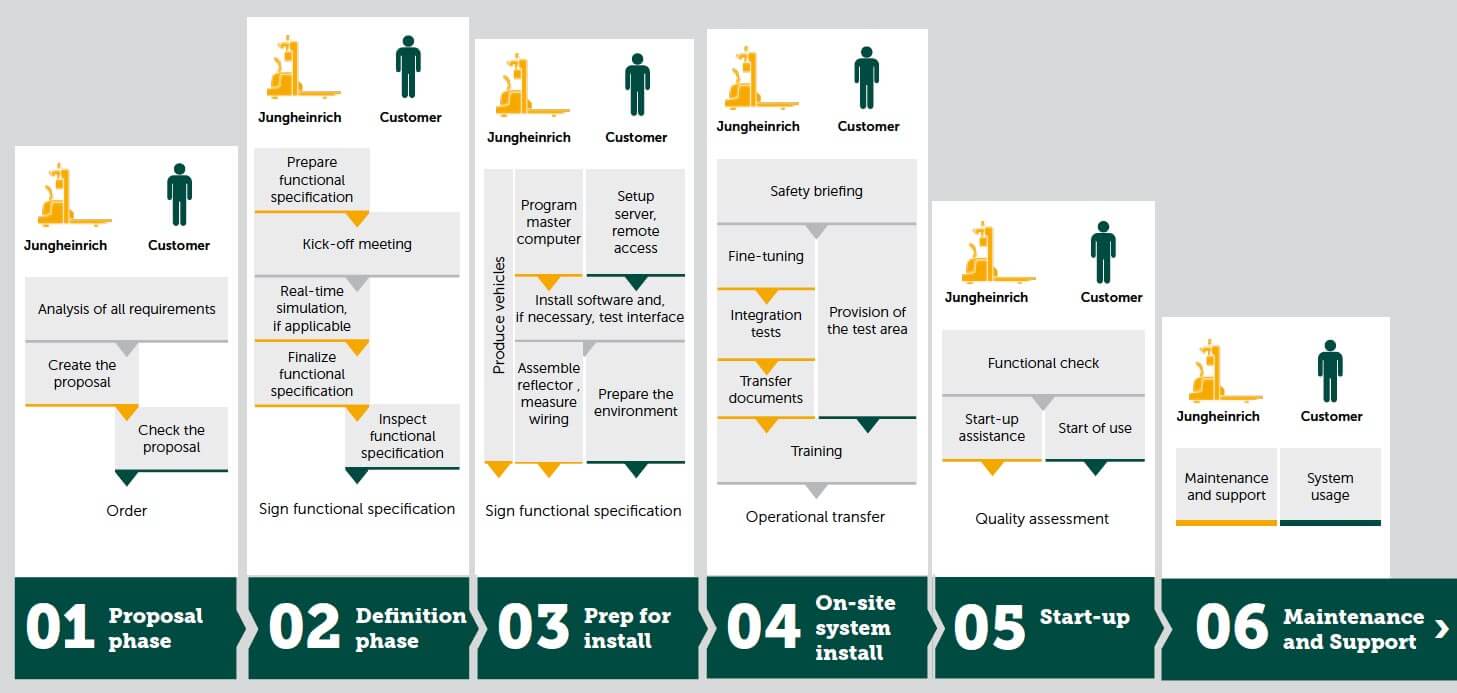
Step 1: Gather Information and Analyze Requirements
The first step in implementing AGVs is understanding your intralogistics needs. This foundational assessment ensures that the automated system aligns with your workflows.
Key areas of analysis include:
- Transport matrix and transport volume
- Pick‑up and drop‑off points
- Load types, load handling requirements, and travel routes
- Special infrastructure considerations such as ramps, gates, or lifts
IT infrastructure must also be reviewed to determine compatibility and data communication needs.
Important IT considerations:
- Is a wireless network available?
- Are you using a Warehouse Management System (WMS)?
- What system interfaces are needed for automation?
Once the full picture is clear, the next step is selecting appropriate AGVs, defining charging concepts, and identifying any required peripheral devices such as I/O boxes, terminals, conveyors, and signal units. Integration can be done as a standalone operation or connected to existing systems via middleware.
Step 2: Define Processes and Create a Functional Specification
After gathering the necessary data, the next phase involves defining technical processes and establishing the functional specification.
Real-Time Simulation (Optional but Valuable)
For complex systems, a real-time simulation can help evaluate:
- Virtual travel routes
- Vehicle behavior
- Peak loads and bottlenecks
- Charging cycles
- Station visits and workflow
Simulations provide valuable insight and decision support, even before implementation begins. Once the system design is confirmed, AGVs can be ordered.
Step 3: Prepare for Implementation
Before AGVs arrive on-site, the software and hardware foundation must be established.
Preparation tasks typically include:
- Installing and testing software for the AGV system
- Programming and testing the master control system and PLC interfaces
- Verifying communication between I/O boxes and peripheral technology
- Installing signal units, wiring, and any necessary navigation markers (if applicable)
The implementation team will map out the navigation environment, finalize route layouts, integrate with the network, and test communication systems. A final interface test ensures the setup is ready for AGV installation.
Step 4: On-Site Installation and System Integration
Once the AGVs arrive, on‑site integration begins.
Employee Introduction and Training
Operators and key users must be trained on:
- Basic troubleshooting
- Vehicle interaction
- Charging procedures
- Safety guidelines for working around AGVs
Because AGVs often operate alongside pedestrians and manual trucks, safety briefings are essential.
Fine-Tuning During Live Operation
Before full deployment, the AGVs undergo on-site testing to confirm:
- Route accuracy
- Efficient pathing
- Alignment with conveyors, doors, lifts, and other automated equipment
Technicians walk alongside the vehicle to identify and correct deviations. After testing and documentation transfer, the system is ready to enter the test phase.
Step 5: AGV System Start-Up and Commissioning
System start-up marks the transition to live automated operation.
During this phase, operators and staff may require additional guidance as they adapt to automated processes. Employees will learn firsthand how AGVs streamline workflows and improve daily material handling tasks.
A final quality assessment then verifies that the system meets operational expectations and performance targets.
Step 6: Ongoing Maintenance and Support
Once the AGV system is fully operational, ongoing support is essential to maintain uptime and optimize performance.
Support typically includes:
- 24/7 technical assistance
- Remote diagnostics
- On-site service visits when needed
- Customized maintenance programs
Reliable support ensures that operations continue smoothly—even during extended or overnight shifts.
Find your local Jungheinrich dealer and ask them about Jungheinrich’s AGVS solutions.