
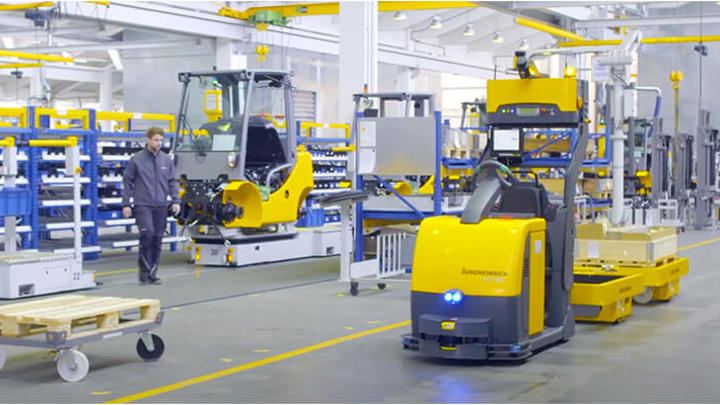
AGV Benefits: Automation & Versatility
The Benefits of AGVs: How Automated Guided Vehicles Improve Profitability, Safety & Productivity
Profitability, safety, and productivity are top priorities for any business—from local retail operations to global distribution networks. Recent disruptions in the supply chain have emphasized the importance of reliable, repeatable processes and accelerated the adoption of warehouse automation. Automated Guided Vehicles (AGVs) are emerging as a critical solution, transforming intralogistics material flows and helping facilities build resilience in even the most unpredictable circumstances.
Below, we explore the many advantages of AGVs and how they support modern material handling operations.
1. Profitability: Increasing ROI Through Automation
For many years, the cost of Automated Guided Vehicles led some businesses to believe they were only feasible for large or multi‑shift operations. While multi‑shift applications still deliver the quickest ROI, advancements in AGV technology, including AGV pallet trucks and automated forklift systems, now make automation accessible and cost‑effective even for single‑shift environments.
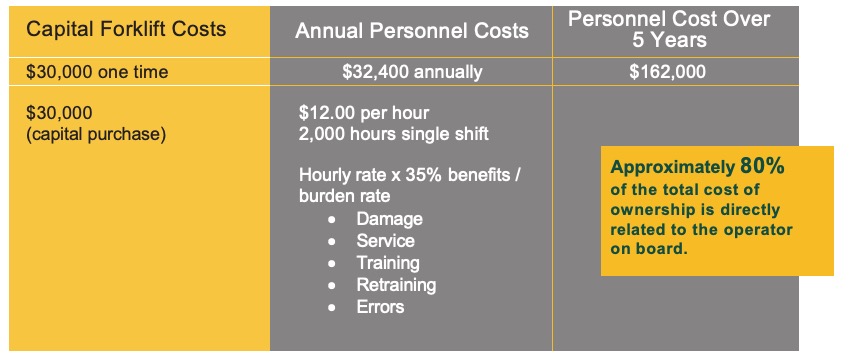
*Costs will vary by model type, company and/or market.
AGVs deliver the greatest financial benefit when used for routine, repeatable tasks. By automating these predictable movements, companies can:
- Reduce operational inefficiencies
- Reallocate employees to higher‑value tasks
- Improve workflow consistency
- Strengthen supply chain stability in times of change
In essence, automation becomes a catalyst for growth, helping businesses build long‑term reliability and operational flexibility.
2. Safety: Advanced Navigation Protects People & Products
Modern AGVs are engineered with sophisticated navigation, detection, and safety technologies that allow them to operate seamlessly within active warehouse environments. Equipped with adaptive sensors, AGVs can detect:
- Pedestrians
- Other material handling equipment
- Racking and obstacles
- Unexpected environmental changes
Depending on speed and proximity, AGVs automatically adjust their detection fields, activate warning signals, or stop movement entirely. Predictable, guided travel paths minimize erratic behavior and reduce collision risks.
In mixed environments with both automated and manual equipment, AGVs:
- Halt safely when their path is blocked
- Resume movement once the route is clear
- Communicate with warehouse systems (e.g., doors, conveyors, pallet drop points)
Every element of AGV design supports a safer warehouse—protecting employees, equipment, and inventory through intelligent automation.
3. Productivity: Smarter Energy & Precision Navigation
AGVs offer far more than autonomous travel—they integrate advanced energy systems and precise navigation technologies that maximize uptime and operational consistency.
Lithium‑Ion Energy Systems
Traditional lift trucks often rely on lead‑acid batteries, which require watering, cooling, changing, and dedicated maintenance space. In contrast, lithium‑ion batteries offer:
- Fast opportunity charging
- Minimal maintenance
- Longer battery life
- Consistent power output
In AGV fleets, lithium‑ion batteries enable automated interval charging, allowing vehicles to stop for quick top‑offs—sometimes as short as 10 minutes—between tasks. This design allows 24/7 AGV operation with no manual intervention, increasing overall warehouse productivity.
Laser-Based Navigation Systems
AGVs equipped with laser navigation can be integrated into existing warehouse layouts with minimal disruption. Reference points around the facility allow AGVs to:
- Identify their exact position
- Navigate efficiently through any racking configuration
- Maintain millimeter‑level accuracy
This level of precision enhances material flow reliability and ensures automated pallet jacks and AGV forklifts consistently place and retrieve loads with exceptional accuracy.
What’s Next for AGV Technology?
AGV technology continues to evolve rapidly. With improvements in robotics, energy systems, and warehouse intelligence, businesses no longer have to choose between automation and operational flexibility. Modern AGVs are becoming:
- More agile
- More intelligent
- Easier to integrate
- Highly scalable
This blending of automated intelligence with human expertise creates a resilient, adaptable workforce equipped to overcome the challenges of a fast‑changing world. As the material handling industry continues to modernize, AGVs will play a crucial role in building sustainable, efficient, and reliable warehouse operations.