
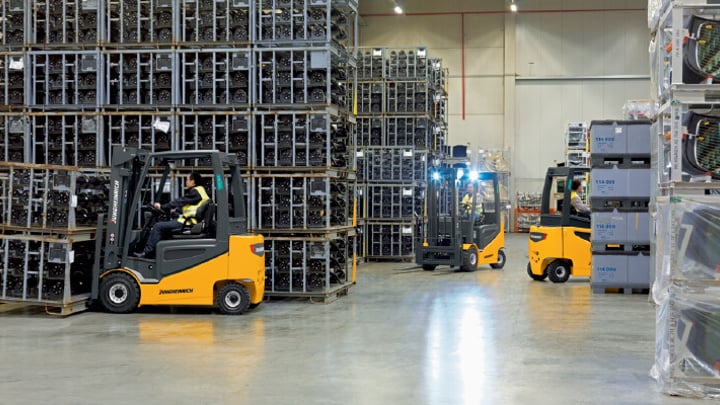
Electric Versus Internal Combustion Forklifts — Which Is Right for Your Operation?
Which is better for your application? Learn the key differences between electric and internal combustion engine lift trucks.
One of the most common questions in material handling today is:
“Should I choose an electric forklift or an internal combustion (IC) forklift?”
Selecting the right lift truck can significantly reduce operating costs, improve productivity, and ensure your equipment matches your environment and workload. Since every facility is different, it’s essential to understand your application before deciding.
Internal Combustion (IC) Forklifts
Best Applications
IC forklifts are ideal for:
- Outdoor applications
- Rough terrain, lumber yards, construction sites
- Operations requiring high capacity lift trucks
If powered by propane (LP), they can also be used indoors with proper ventilation.
Advantages of IC Forklifts
- Lower upfront cost
- Excellent for long travel distances, high speeds, and inclines
- Capacities over 35,000 lbs available
- Fast refueling with LP tank changes or diesel/gas pumps
Disadvantages of IC Forklifts
- Indoor use requires proper ventilation
- Higher maintenance costs (more moving engine components)
- Fuel costs can be higher depending on propane or diesel prices
Refueling Considerations
The key advantage of an IC forklift is instant refueling:
- Swap LP tanks in minutes
- Refuel diesel or gasoline at an OSHA‑approved station
However, some operations may require multiple refuels during a shift depending on usage.
Maintenance
IC forklifts require:
- Regular engine inspections
- Oil and filter changes
- More frequent maintenance to control long‑term repair costs
Performance Strengths
IC forklifts excel in:
- Heavy‑duty outdoor applications
- Handling large, heavy loads like brick, lumber, and construction materials
Electric forklifts have historically been reserved for lighter indoor applications, but modern designs now allow certain models to perform outdoors as well.
Electric Forklifts
Best Applications
Electric forklifts are ideal for:
- Indoor environments
- Operations prioritizing low noise, zero emissions, and low operating costs
Many models with sealed components can operate outdoors in select conditions.
Advantages of Electric Forklifts
- Zero emissions (better indoor air quality)
- Lower maintenance costs (fewer moving parts)
- Lower fuel cost—electric charging vs. propane or diesel
- Longer economic life in many applications
- Quieter operation
- Narrower aisle requirements, increasing storage density
Disadvantages of Electric Forklifts
- Higher initial purchase cost
- Limited model availability over 15,000 lbs
- Requires on‑site battery charging stations
- Operators need battery maintenance training
Recharging Considerations
Key factors for electric forklift operations:
- Most forklift batteries need 8 hours to charge and 8 hours to cool
- A single charge may last 3–12 hours, depending on workload
- Multi‑shift operations may require additional batteries
Battery condition and maintenance significantly impact run time.
Fuel Cost Advantages
Electric forklifts run on battery power, resulting in substantial long‑term fuel savings compared to propane, diesel, or gasoline.
Maintenance Advantages
With fewer moving parts, electric forklifts have:
- Lower maintenance requirements
- Reduced labor costs
- Less downtime
Learn More
Still deciding between electric vs. IC forklifts?
Contact your local authorized Jungheinrich forklift dealer to compare specific models and find the lift truck best suited for your application.
Frequently Asked Questions About IC & Electric Forklifts
What kind of fuel does a forklift use?
Common IC forklift fuel types include:
- Compressed Natural Gas (CNG)
- Diesel
- Gasoline
- Liquid Petroleum (LP) Gas
Can you use a propane forklift indoors?
Yes—propane forklifts can be used indoors if:
- Adequate ventilation is available
- The space is large enough to disperse exhaust
- You avoid extended indoor operation in tight or enclosed spaces, such as trailers
Proper ventilation is especially important in winter when doors and windows are closed.