
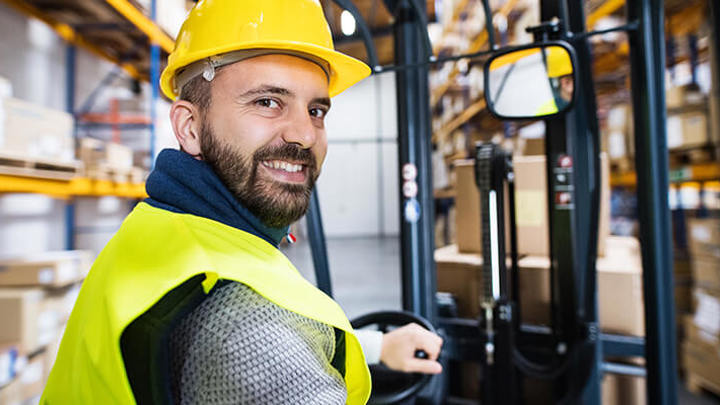
Types of Forklifts Explained
Trying to find the best forklift for your operation? With so many lift truck models, power options, and configurations available, selecting the right forklift can feel overwhelming. This guide outlines the most common forklift types and key factors to consider so you can make an informed, productive choice.
What Types of Forklifts Are Available?
Before choosing a forklift, it’s essential to understand your options and how each type fits into different material handling applications. Here are some of the most widely used forklift categories:
- Electric forklifts
- Internal combustion (IC) forklifts
- 3‑wheel forklifts
- 4‑wheel forklifts
- Pantograph reach trucks
- Moving mast reach trucks
- Narrow aisle forklifts
- Order pickers
- Turret trucks
- Hand pallet trucks
Internal Combustion vs. Electric Forklifts
Many buyers start by choosing between electric and internal combustion (IC) forklifts. Each offers unique advantages depending on your application, environment, and operating hours.
Electric Forklifts
Electric forklifts are ideal for indoor warehouses and spaces where emissions and noise reduction are important.
Benefits of electric forklifts:
- Lower maintenance costs
- Zero emissions for indoor air quality
- Quiet operation
- Longer equipment lifespan
- Lower long‑term operating costs
- Energy‑efficient warehouse performance
While electric forklifts typically have higher upfront costs due to the battery and charger, modern technology allows many models to run extended shifts on a single charge—often eliminating the need for mid‑shift battery changes.
Internal Combustion (IC) Forklifts
IC forklifts are commonly used outdoors or in heavy‑duty applications requiring high torque and lifting capacity.
Benefits of IC forklifts:
- Strong power and acceleration
- Fast refueling
- High lift capacities (varies by model)
- Excellent performance in rugged environments
IC forklifts are available in diesel, gasoline, and LPG (liquefied petroleum gas) options, each offering its own advantages for outdoor or mixed‑use operations.
3‑Wheel vs. 4‑Wheel Forklifts
The number of wheels plays a major role in maneuverability, stability, and application suitability.
3‑Wheel Forklifts
Best for: Tight warehouse spaces and narrow aisles
Advantages:
- Smaller turning radius
- Highly maneuverable
- Ideal for indoor applications
- Efficient in high‑density storage environments
4‑Wheel Forklifts
Best for: Outdoor or uneven surfaces
Advantages:
- Greater stability
- Better gradeability for slopes
- Higher lifting capacities
- Strong performance on rough terrain
These trucks are preferred in applications requiring power, traction, and durability.
Pantograph Reach Trucks
Pantograph reach trucks are built for warehouses with tall racking systems. Their extending forks allow operators to “reach” into storage racks without moving the truck itself.
Advantages:
- Excellent maneuverability in tight aisles
- Efficient pallet handling at height
- Ideal for high‑density storage
Moving Mast Reach Trucks
Moving mast reach trucks shift the mast forward and backward rather than using extending forks.
Advantages:
- Easier load placement at height
- Increased operator confidence and control
- Efficient in applications requiring frequent high‑level pallet handling
Narrow Aisle Forklifts
Narrow aisle (NA) and very narrow aisle (VNA) forklifts are designed to maximize warehouse space by operating in reduced aisle widths.
Advantages:
- Significant space savings
- Increased storage density
- Ideal for warehouses with tall, narrow racking
Order Pickers
Order pickers lift the operator to the height of the racking, making them ideal for picking individual items rather than full pallets.
Benefits:
- Fast, accurate order picking
- Improved labor efficiency
- Available in low‑, mid‑, and high‑level options
Turret Trucks
Turret trucks are VNA forklifts with rotating forks, allowing them to pick or place pallets on either side of the aisle without turning the truck.
Benefits:
- Exceptional storage density
- Faster pallet handling in narrow aisles
- Reduced travel time and increased throughput
Hand Pallet Trucks
Hand pallet trucks—also known as pallet jacks—are simple, manually operated lift trucks used for ground‑level pallet movement.
Benefits:
- Low cost
- Easy to operate
- Perfect for small warehouses or retail spaces
- No emissions or power source required
Hand pallet trucks are not suitable for stacking or high‑level lifting but remain a warehouse essential.
Final Thoughts
Selecting the right forklift is essential for improving productivity, safety, and efficiency. By understanding your application and the wide range of forklift types available—including electric, IC, 3‑wheel, 4‑wheel, reach trucks, order pickers, turret trucks, and pallet jacks—you can confidently choose the lift truck that best fits your operation.
For personalized guidance, consult your local Jungheinrich forklift dealer to assess your application and recommend the most suitable equipment.