
Understanding AGVs and How They Support Warehouse Automation
As Automated Guided Vehicles (AGVs) continue gaining traction in the material handling and warehouse automation industry, many operations are exploring whether AGVs are right for them. Common questions include: What does AGV stand for? How do AGVs work? Why are they becoming so popular?
This guide answers the most frequently asked questions about AGVs and explains how they can enhance productivity, reduce labor costs, and support scalable automation.
What Are AGVs?
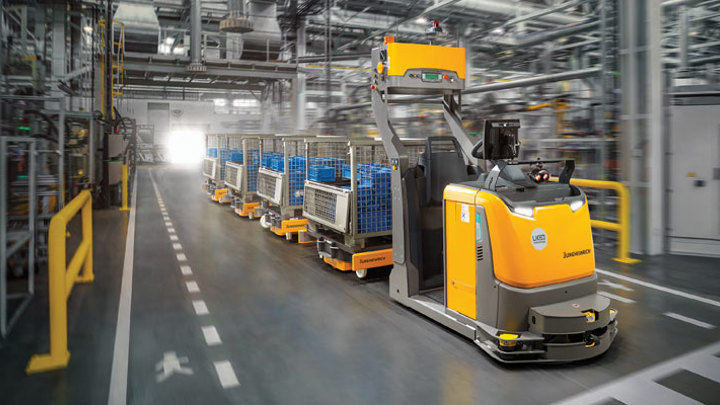
AGVs (Automated Guided Vehicles) are autonomous load‑carrying vehicles used to move materials within warehouses, manufacturing facilities, distribution centers, and other industrial environments. Unlike traditional forklifts, AGVs do not require an onboard operator. Instead, they rely on software, sensors, and onboard navigation systems to transport loads with precision.
AGVs are ideal for repetitive material transport, pallet movement, and consistent internal logistics workflows. By automating these tasks, facilities can reallocate workers to more specialized responsibilities, improve safety, and streamline overall intralogistics efficiency.
Although AGVs can run fully autonomously, most models are designed to operate safely alongside pedestrians, manual forklifts, and other warehouse vehicles. Some AGVs can even be switched into manual mode when needed—offering flexibility for dynamic operations.
How Do AGVs Work?
Most AGVs are battery powered and operate along virtual or predefined navigation paths. Depending on the model, AGVs may use:
- Magnetic tape guidance
- Laser guidance systems
- Optical sensors and cameras
- LiDAR for obstacle detection
A central software platform connects wirelessly to each AGV, allowing operators to track real‑time locations and dispatch tasks. This software may integrate with existing Warehouse Management Systems (WMS) or operate independently.
AGV commands may include starting and stopping, adjusting speeds, turning, lifting, lowering, and other load‑handling functions. This level of coordination optimizes travel paths, reduces congestion, and improves the consistency of material flows—ultimately lowering operating costs.
Types of AGVs
AGVs come in multiple configurations based on application, capacity, and movement requirements. The most common types include:
Forklift AGVs
Standard forklifts adapted for autonomous operation, capable of pallet transport, stacking, and storage tasks.
Unit Load AGVs
Vehicles equipped with decks, forks, or conveyors for handling loads individually without a trailer.
Tow Tractor AGVs
Designed to pull multiple carts or trailers for high‑volume material movement.
Automated Guided Carts (AGCs)
Compact carts ideal for assembly lines, kitting workflows, and point‑to‑point material transport.
Because AGVs vary widely in lift height, towing capacity, and maneuverability, operations can choose the model best suited for their workflow and space constraints.
Are AGVs a Good Fit for Your Operation?
AGVs can be deployed in nearly any industry that uses material handling equipment, including manufacturing, warehousing, automotive, food and beverage, pharmaceuticals, and more.
Before adopting AGVs, consider evaluating:
- Current intralogistics processes
- WMS and IT system compatibility
- Daily transport volumes
- Pickup and drop‑off locations
- Floor conditions, ramps, tunnels, or low‑clearance areas
- Fleet size and labor allocation
A thorough workflow analysis helps determine which AGV models are compatible with your operational demands and how automation can support long‑term efficiency goals.
Do AGVs Require Employee Training?
Yes. Like any new warehouse technology, AGVs require proper introduction and training. Even though AGVs automate many tasks, employees must understand:
- Basic AGV functionality
- Troubleshooting and alerts
- Safe interaction with mixed‑fleet traffic
- Charging procedures
- Emergency protocols
Because AGVs often operate in environments shared with pedestrians and manual forklifts, safety training and operator awareness are essential for successful integration.
Partner with the Best in the Industry
Jungheinrich has a proven track record of more than 60 years of technologically advanced forklift design experience, as well as more than 10 years of automation experience. When you partner with Jungheinrich, you work with experts who will develop the right automation solution for your workplace.
Find your local Jungheinrich dealer to get started.