
Forklift Mast Types: How to Choose the Right Mast for Your Application
Last Updated: September 14, 2026
Choosing the right forklift mast can significantly impact productivity, safety, and storage efficiency. Whether you're loading trailers, operating in low-clearance areas, or accessing high warehouse racking, the mast configuration on your forklift determines how high you can lift, how much overhead clearance you'll need, and how effectively operators can handle loads.
This guide explains the most common forklift mast types, how forklift masts work, and which mast configuration is best suited for different material handling applications.
What Are the Main Types of Forklift Masts?
The four primary forklift mast types are:
- Simplex Mast: Single-stage mast designed for low lift heights.
- Duplex Mast: Two-stage mast that offers limited free lift.
- Triplex Mast: Three-stage mast providing higher lift heights with compact collapsed height.
- Quad Mast: Four-stage mast capable of reaching maximum lift heights for high-density storage applications.
The best forklift mast depends on your warehouse ceiling height, rack configuration, visibility requirements, and lifting needs.
What is a Forklift Mast?
A forklift mast is the vertical lifting assembly mounted on the front of a forklift. The mast supports the carriage and forks while using hydraulic cylinders, chains, and rails to safely raise and lower loads.
Forklift masts are typically classified based on:
- Lift mechanism design
- Number of mast stages
- Available free lift
- Maximum lift height
- Collapsed mast height
Selecting the correct mast helps improve storage density, reduce operator risk, and maximize material handling efficiency.
Standard Mast vs. Full Free Lift Mast
Before selecting a mast type, it is important to understand how free lift affects forklift performance.
What Is a Standard Mast?
A standard mast raises both the forks and mast channels at the same time. Because the mast extends during lifting, it requires additional overhead clearance.
Best for:
- Outdoor applications
- Yard operations
- Open warehouses
- Loading and unloading trucks
- What Is a Full Free Lift Mast?
A full free lift mast allows the forks to rise without increasing the overall mast height. This enables operators to lift loads within trailers, shipping containers, railcars, or facilities with low ceilings.
Best for:
- Shipping containers
- Truck trailers
- Low-clearance warehouses
- Mezzanine storage areas
While highly versatile, full free lift masts may slightly reduce forward visibility because of the additional hydraulic components located within the mast assembly.
Forklift Mast Types at a Glance
| Mast Type | Stages | Typical Lift Height | Best Application |
| Simplex | 1 | Low | Truck loading and ground-level stacking |
| Duplex | 2 | Medium | Cross-docking and double stacking |
| Triplex | 3 | High | Warehouse racking and reach truck operations |
| Quad | 4 | Very High | High-density storage and specialized warehousing |
4 Common Mast Types
Today, forklift operators typically depend upon any one of four different forklift mast types. Manufacturers do not always use uniform terminology to refer to these components. One company may describe its masts in terms of the lift mechanisms, while another may base its descriptions of masts on the number of mast sections.
The four main forklift mast types are simplex, duplex, triplex, and quad masts. The right mast depends on lift height requirements, overhead clearance, warehouse rack dimensions, and application needs.
1. Simplex Mast
- Basic design with one stationary outer rail and one sliding inner rail
- Limited lift height—ideal for loading trucks or low stacking
Usually these forklifts can lift loads only limited distances. For instance, they may lift cargo onto the back of a truck.
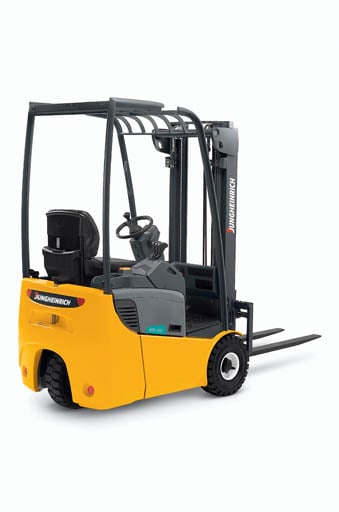
This common type of standard forklift mast employs an arrangement of a stationary outer rail and a sliding inner rail with chains to lift a carriage and forks. The maximum extension of the inner rails will limit the height of load lifting.
2. Duplex Mast
- Includes a hydraulic cylinder for free lift
- Great for double-stacking and cross-docking
- Also called Two-Stage Free Lift Mast
This mast is the optimal choice when loads need to be double-stacked and the lift truck will not be placing such loads into high racking. Material handling application examples include freight cross-docking and manufacturing component delivery operations. (Also known as: Duplex Upright or Two-Stage Free-Lift Mast).
This type of mast has a hydraulic cylinder located in the center of the mast assembly that helps push loads upwards, enabling the load to rise while the mast itself remains stationary. Once the carriage reaches the top of the inner rails, two supporting side rails complete the lifting process.
3. Triplex Mast
- Most popular mast type
- Offers higher lift heights for high racking
- Common on reach trucks
- Also known as Triple Stage Upright
These widely used masts have become the most popular recently. They enable loading and unloading at higher elevations than duplex masts.
A Triplex mast differs from the Duplex because it includes two sliding rails plus a single stationary rail: it is often found on a reach truck as it can extend a load further to reach greater distances. A large hydraulic ram in the center of the mast assembly performs most of the lifting of the forks and carriage. Secondary hydraulic cylinders lift the middle sections and a chain system, which pulls the inner section and the carriage when the mast is fully extended. (Other terms for this type of mast: Third Stage Mast, FSV Mast, Triple Mast, Triple Stage Upright).
4. Quad Mast
- Provides the highest lift heights
- Requires advanced operator training
- Ideal for very high stacking in specialized applications
As the name suggests, this complex mast depends on four sets of rails and chains to move loads. Forklift operators typically require advanced training in order to use this type of mast, which reaches much higher elevations and may have restricted visibility.
A Quad mast can provide full free lift as it operates similarly to the Triplex. However, its powerful hydraulic secondary cylinder rails and chains permit extra extension. (Also known as: QFV Mast, or Four Stage Mast).
How Do You Choose the Right Forklift Mast?
When evaluating forklift mast options, consider the following factors:
Storage Rack Height
The mast must reach the highest pallet position while maintaining load stability and adequate capacity.
Ceiling and Doorway Clearance
A mast's collapsed height must fit through door openings and operate safely beneath ceilings, sprinklers, and overhead obstructions.
Visibility Requirements
Some multi-stage masts and full free lift designs may slightly reduce operator visibility. Applications requiring precise load placement may benefit from enhanced visibility mast designs.
Lift Truck Application
Different applications often require different mast configurations:
- Trailer loading: Simplex or Duplex
- Cross-docking: Duplex
- Warehouse racking: Triplex
- High-density storage: Quad
- Reach truck operations: Triplex
- Operator Experience
Higher-reaching masts require greater awareness of load center, stability, and visibility. Ensure operators receive appropriate training for the equipment configuration being used.
Key Takeaways
- Choose a mast based on rack height, aisle space, and load requirements
- Full free lift masts are best for low-clearance areas
- Triplex and Quad masts are ideal for high stacking
Choosing the Best Forklift Mast for Your Operation
The right forklift mast can improve productivity, maximize storage space, and help operators work more safely and efficiently. While simplex and duplex masts are ideal for lower lift applications, triplex and quad masts provide the reach needed for modern warehouse environments and high-density storage systems.
When selecting a forklift mast, evaluate your facility's ceiling height, rack configuration, lift requirements, and visibility needs to ensure the best fit for your operation.
For expert guidance on forklift mast selection, capacity requirements and warehouse optimization, contact your local Jungheinrich dealer today.
Frequently Asked Questions About Forklift Masts
The triplex mast is the most commonly used forklift mast because it provides excellent lift height while maintaining a relatively low collapsed height for warehouse operation.
A duplex mast has two stages and typically offers lower maximum lift heights. A triplex mast includes three mast stages and can reach higher rack levels while maintaining better collapsed height characteristics.
Full free lift allows the forks to rise without increasing the overall height of the mast. This feature is especially useful inside trailers, containers, and low-ceiling facilities.
Triplex masts are typically the preferred choice for warehouse racking because they provide the lift height needed for most pallet storage systems while maintaining maneuverability.
A quad mast is used in applications requiring extremely high lift heights, such as high-density warehousing and specialized storage environments.
Yes. Maximum forklift capacity can vary depending on mast configuration and lift height. As lift height increases, effective load capacity may decrease due to changes in load center and stability.