
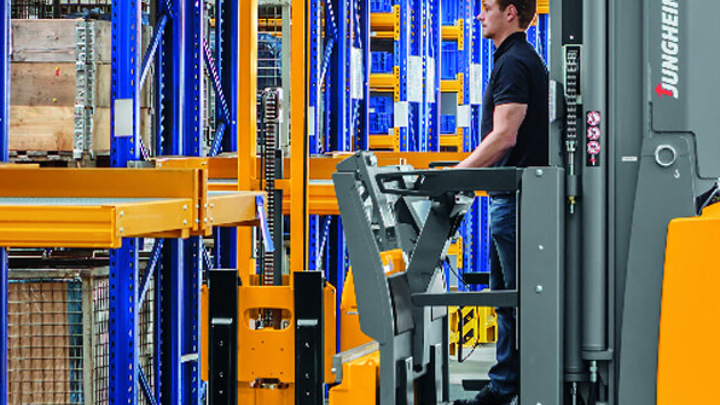
How to Improve Warehouse Efficiency: 3 Proven Strategies for Faster, More Accurate Operations
Warehouse efficiency is the ability to receive, store, pick and ship products using the least time, labor and cost, while keeping accuracy high. It is getting harder to achieve. Product assortments keep growing, delivery windows keep shrinking and experienced labor is harder to find.
Last Updated: October 2, 2026
In the 2026 MHI Annual Industry Report, produced with Deloitte, supply chain leaders ranked "workforce, talent shortage and changing worker skillsets" as the second-biggest trend affecting their operations. Only economic uncertainty, inflation and geopolitical risk ranked higher. The same survey found that 56% of organizations expect to increase spending on supply chain innovation, and 52% expect to spend more than $1 million.
Most efficiency gains don't require a bigger building or a bigger crew. They come from three places: how far people and trucks travel, whether the equipment fits the task, and how much guidance technology gives the operator.
Where Warehouse Time Actually Goes
Order picking is the most labor-intensive activity in most warehouses. A widely cited review in the European Journal of Operational Research estimates it can account for as much as 55% of total warehouse operating expense. The largest share of a picker's day isn't spent picking:
|
Order picker activity |
Approximate share of time |
|
Travel between locations |
50% |
|
Searching for the item or location |
20% |
|
Picking |
15% |
|
Setup (receiving instructions, getting equipment) |
10% |
|
Other |
5% |
Source: de Koster, Le-Duc and Roodbergen (2007), citing Tompkins et al. Travel and search together take about 70% of the day. That's why the strategies below start there: a few seconds saved per trip adds up across thousands of picks a day.
Layout decisions affect travel time, congestion, storage capacity and safety. A useful first exercise is to trace how product moves from receiving to storage to picking to shipping. Wherever the path doubles back or crosses itself, you are paying for extra travel.
Common improvements include:
- ABC classification. Identify the small group of SKUs that generates most of your picks. Place them closest to packing and shipping, at waist-to-shoulder height.
- Scheduled re-slotting. Review slotting quarterly and before seasonal peaks, not only when space runs out. New SKUs tend to go wherever there is room, and that's how travel paths creep longer.
- WMS-directed putaway. Let the warehouse management system assign locations based on velocity and size, not operator habit.
- Batch and zone picking. Pick several orders in one trip, or assign pickers to zones, so fewer trips cover the same work.
- Denser storage where it shortens travel. Narrower aisles and taller racking bring more locations within reach, as long as the equipment is built to work in them.
2.Match the Equipment to the Task
The wrong truck for a task adds travel, handling and wait time. A counterbalance forklift doing case picking, or a reach truck shuttling pallets across a long dock, costs time on every trip. Most modern warehouses run a mix of equipment:
|
Task |
Equipment typically used |
Why it fits |
|
Case picking at floor and first levels |
Low-level order pickers |
Operators step on and off quickly and pick directly from the pallet or lower rack levels |
|
Case and piece picking at height |
High-level (man-up) order pickers |
The platform raises the operator to the pick face |
|
Horizontal pallet moves, dock work |
Walkie or rider pallet trucks |
Compact, fast and low cost per move |
|
Putaway and retrieval in narrow aisles |
Reach trucks |
Reach into racking from aisles narrower than a counterbalance truck needs |
|
Very high-density storage |
Turret (very narrow aisle) trucks |
Work in the narrowest aisles and combine pallet handling with picking at height |
|
General pallet handling, loading and unloading |
Electric counterbalance forklifts |
Versatile, and no exhaust emissions indoors |
Equipment choice also affects downtime. Lithium-ion batteries can be opportunity-charged during breaks and shift changes. This can eliminate mid-shift battery swaps, along with the space and labor a battery room needs. Whether that pays off depends on your shift pattern, charging infrastructure and utilization.
3.Add Semi-Automation Before Full Automation
Technology helps most when it attacks the travel and search time shown above. Many facilities start with targeted tools and expand from there:
- Picking technology: RF scanning, voice-directed picking and pick-to-light systems cut search time and errors by telling the picker exactly where to go and what to pick.
- Semi-automated trucks: some very narrow aisle and order-picker trucks read RFID tags in the floor to know their exact position. The system directs the truck to the correct rack location and combines driving and lifting in the most efficient path. The operator stays in control.
- Full automation: automated guided vehicles (AGVs), autonomous mobile robots (AMRs) and automated storage and retrieval systems (AS/RS) take over repetitive transport and storage tasks.
- Data: labor management software and performance dashboards show where time is being lost.
Interest in automation is high but measured. In the 2026 MHI Annual Industry Report, 73% of respondents expect to adopt robotics and automation within five years, and 39% say its impact on supply chains is already significant or greater. That's up 16 percentage points from the previous year.
Semi-automation is often the practical first step. It costs less than a fully automated system, works alongside existing people and processes, and keeps operators in control. It also builds the data and discipline an operation needs if it later moves to full automation.
How to Measure Warehouse Efficiency
You can't improve what you don't measure. Set a baseline before making changes, then track the same metrics afterward.
|
Metric |
What it tells you |
|
Travel time per pick |
Whether layout and slotting changes are working |
|
Lines or units picked per labor hour |
Overall labor productivity |
|
Order picking accuracy |
Whether speed is costing you errors |
|
Inventory accuracy |
How much search time comes from bad location data |
|
Order cycle time |
How long an order takes from release to ship |
|
Dock-to-stock time |
How quickly receipts become available inventory |
|
Space utilization |
How much of your cube is actually in use |
|
Equipment utilization |
Whether you have too many, too few or the wrong trucks |
|
On-time shipment rate |
What the customer experiences |
Where to Start
- Set your baseline. Capture the metrics above for a typical week.
- Study the travel. Follow a few pickers and drivers for a shift and see how much of their time is travel and search.
- Re-slot your fastest movers. It is usually the quickest, lowest-cost win.
- Audit equipment against tasks. Look for trucks doing jobs they weren't designed for.
- Pilot one technology in one zone. Measure the result before scaling.
Efficiency gains rarely come from a single project. The operations that improve most treat it as continuous improvement: measure, change one thing, measure again.
Ready to find the efficiency in your operation? Jungheinrich order pickers, turret trucks and Warehouse Navigation are built to reduce travel and search time in narrow-aisle warehouses. Explore Jungheinrich solutions or talk with a Jungheinrich dealer about an assessment of your operation.
Sources
- MHI and Deloitte, "Rewiring the Future: A Supply Chain Playbook for Innovation," 2026 MHI Annual Industry Report. Summarized in MHI Solutions, June 26, 2026 and Business Wire, April 2026.
- de Koster, R., Le-Duc, T., and Roodbergen, K. J. (2007). "Design and control of warehouse order picking: A literature review." European Journal of Operational Research, 182(2), 481–501. doi:10.1016/j.ejor.2006.07.009
- Logisnext Americas, Jungheinrich Warehouse Navigation (manufacturer claim).
Frequently Asked Questions
In most picking operations it is travel. Research summarized by de Koster et al. (2007) puts travel at roughly half of an order picker's time, and searching at another fifth.
A WMS directs putaway and picking, keeps inventory locations accurate and shows where work is backing up. All three cut travel and search time.
It can, by reducing travel, errors and repetitive manual work. Many operations start with semi-automation, such as guided picking or RFID-guided trucks, before investing in fully automated systems.
It depends on pick height, order profile and aisle width. Low-level order pickers suit floor-level case picking, high-level order pickers suit picking at height, and turret trucks suit very narrow aisle, high-density storage.