
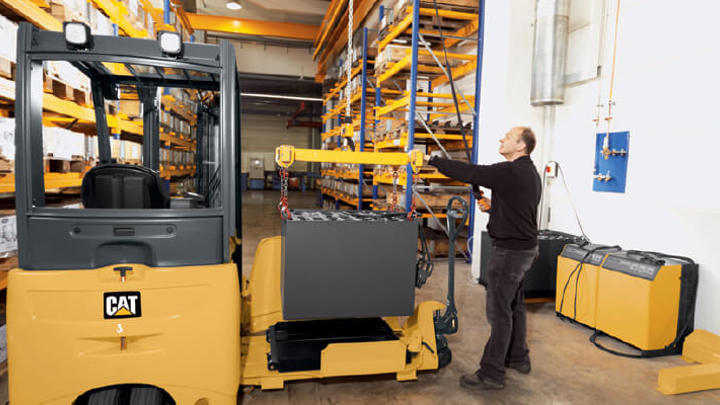
Forklift Battery Charging Station Layout: Best Practices to Boost Warehouse Efficiency
Battery charging can significantly influence warehouse productivity. Every minute spent changing or charging a battery is time not spent moving goods. By designing a battery room based on best practices, you’ll reduce travel time, minimize equipment wear, and extend the life of your fleet’s lead-acid industrial batteries. Below are the key elements of an optimal forklift battery charging station layout.
1) Choose the Right Location
Plan for space, traffic flow, and growth.
Select a location that allows lift trucks and pallet trucks to enter, stage, and exit without bottlenecks. Account for battery storage and service lanes. If you manage a large fleet, vertical storage systems can save up to 50% floor space and support future expansion.
Place near power and working areas.
Minimize travel time from main work zones and position the room close to a main power feed to reduce installation and operating costs. When sizing power, include all auxiliary loads such as ventilation, hydrogen detection, and cooling systems.
Design for safety and compliance.
Your battery room should support:
- Plumbing and drainage for emergency eyewash and showers.
- Ventilation adequate for hydrogen off-gassing, with hydrogen gas detectors tied to fans/alarms as required.
- PPE storage (acid-resistant face shields, goggles, aprons, gloves) and spill kits for acid leaks.
- Clearly marked egress routes, safety signage, and training protocols.
Note: Follow applicable OSHA, EPA, and NFPA standards for industrial battery charging environments. Consult your local authority having jurisdiction (AHJ) for site-specific requirements.
2) Equip for Efficient Battery Changing
Lead-acid batteries are heavy—safe, efficient handling equipment is essential. Start by answering:
- Do your forklifts use overhead or side extraction?
- How much floor space is available for changers and staging?
- How many battery changes per shift/day are required?
Overhead extraction options
- Gantry cranes or overhead systems eliminate the need for a second truck and work well when vertical clearance and structural support are available.
Side extraction options
- Manual or powered transfer carriages for moderate duty cycles.
- Park-and-charge systems for predictable traffic flows.
- Operator Aboard Battery Extractors (OABE) for high-volume fleets to maximize throughput and safety.
Implement smart battery rotation.
Inefficient rotation reduces runtime and battery life. Use:
- FIFO racks that select the battery that’s been idle the longest, or
- Intelligent multi-charger systems that choose by charge completion time or state-of-charge.
Even a simple, documented log enables proper rotation and extends battery life.
3) Install Flat, Approved Flooring
Your battery room floor must be acid-resistant and compliant with OSHA/EPA/NFPA requirements. Flatness is critical—especially for OABE systems that operate on defined paths:
- Uneven floors cause vibration, flex, and stress that reduce equipment productivity.
- At higher lift heights, floor deviations are magnified, increasing wear and risk.
- Specify an appropriate F-min flatness rating to ensure safe, precise operation and reduce repairs, downtime, and injury potential.
4) Optimize Charger Storage and Access
Mount chargers correctly to save space and meet OSHA guidance.
- Use purpose-built shelves and secure all four corners.
- Follow manufacturer spacing and ventilation requirements—especially for stacked configurations.
- Position shelves so DC cable leads reach batteries without exceeding recommended cable length.
Plan for maintenance access.
- Provide catwalks or multi-level shelving with clear access for inspection, cleaning, and repair.
- Label chargers, circuits, and battery positions for quick diagnostics.
Quick Checklist
- Adequate space and clear travel paths
- Vertical storage for batteries (if applicable)
- Proper ventilation + hydrogen detection
- Emergency eyewash/shower + drainage
- PPE and spill kit storage
- Correct handling equipment (overhead/side)
- Documented battery rotation (FIFO/intelligent systems)
- Flat, acid-resistant floor with F-min compliance
- Mounted chargers with proper spacing and cable length
- Easy maintenance access and labeling
Need help laying out your battery room? Contact our energy solutions team for a site survey, equipment recommendations, and compliance review.